

Curriculum and Assessment Review
The new national curriculum is coming. Schools that start preparing now will have a smooth transition.
Schools can’t risk waiting until 2028. Here’s what you can do to ensure you are ahead.
Change in education is constant. But some changes are bigger than others. The Government’s Curriculum and Assessment Review brings with it a new national curriculum that forward-thinking schools will be utilising from September 2027, a full year before it becomes statutory.
September always comes around faster than expected. And curriculum change takes longer than schools anticipate. The schools that will be ahead in 2028 are the ones making decisions now.
Cornerstones has been here before. We supported schools through the curriculum changes of 2014 and 2019. We know what it takes to help you stay ahead of the game. And we have already been working towards these changes so that you do not have to start from scratch.


What the Curriculum and Assessment Review means for your school
The phrase that runs throughout the review is evolution, not revolution. The new national curriculum builds on what already exists rather than replacing it wholesale. For most primary schools, the broad shape of what is taught will remain familiar.
But evolution still creates change. Any revision to programmes of study has a ripple effect through primary curriculum content and cohesion. Knowledge and skills frameworks need updating, resources need reviewing, assessment needs realigning and monitoring and evaluation systems need reconfiguring to reflect new expectations.
Many schools have spent years building their current curriculum. They know how much time and resource that took. The Curriculum and Assessment Review asks them to do it again, within a defined timeframe, while continuing to run a school.
Read our full summaryThe hidden complexity of curriculum change
Updating a curriculum is rarely just a matter of swapping one scheme for another. Here is what schools consistently underestimate.
Content and sequencing
Every subject needs reviewing against the new programmes of study. Knowledge and skills need resequencing across year groups. Gaps and overlaps need identifying and resolving. This takes time even with the right tools in place.
Resources
Lesson plans, teaching resources, knowledge organisers and assessment materials all need updating to reflect new content. Without a platform that connects these automatically, the workload falls on individual teachers and subject leaders.
Assessment
Assessment frameworks need realigning to new end points and expectations. Schools using disconnected assessment tools face the additional challenge of rebuilding those connections from scratch.
Budget
Curriculum change has unavoidable costs. New resources, staff development time, non-contact time for curriculum design and review. Starting early spreads those costs across a more manageable window. Waiting compresses them into a single high-pressure year.
Staff development
Teachers and subject leaders need time to understand, internalise and feel confident with new curriculum content and expectations. That confidence cannot be built in a term. It needs to be developed over time, with the right support in place.
Leadership capacity
Senior leaders need to be able to articulate the school’s curriculum intent, implementation and impact under the new framework. Building that narrative takes time. It cannot be done retrospectively the week before an inspection.
We have already done the hard work, so you do not have to.
While schools have been navigating the day-to-day demands of teaching, Cornerstones has been preparing for the new national curriculum. We have created a new Cornerstones Curriculum that schools can introduce before the statutory changes take effect in September 2028.
Because the curriculum is housed on Maestro, our digital curriculum platform, it will be fully aligned with the new national curriculum when schools are ready to switch. There is no need to start from scratch. Just a smooth, managed transition at a pace that works for your school.
This is not the first time Cornerstones has helped schools navigate curriculum change. We supported schools through the 2014 national curriculum and again through the 2019 inspection framework changes. We know what the transition looks like, we know where schools get stuck and we know how to help them stay ahead.
Find out more about Maestro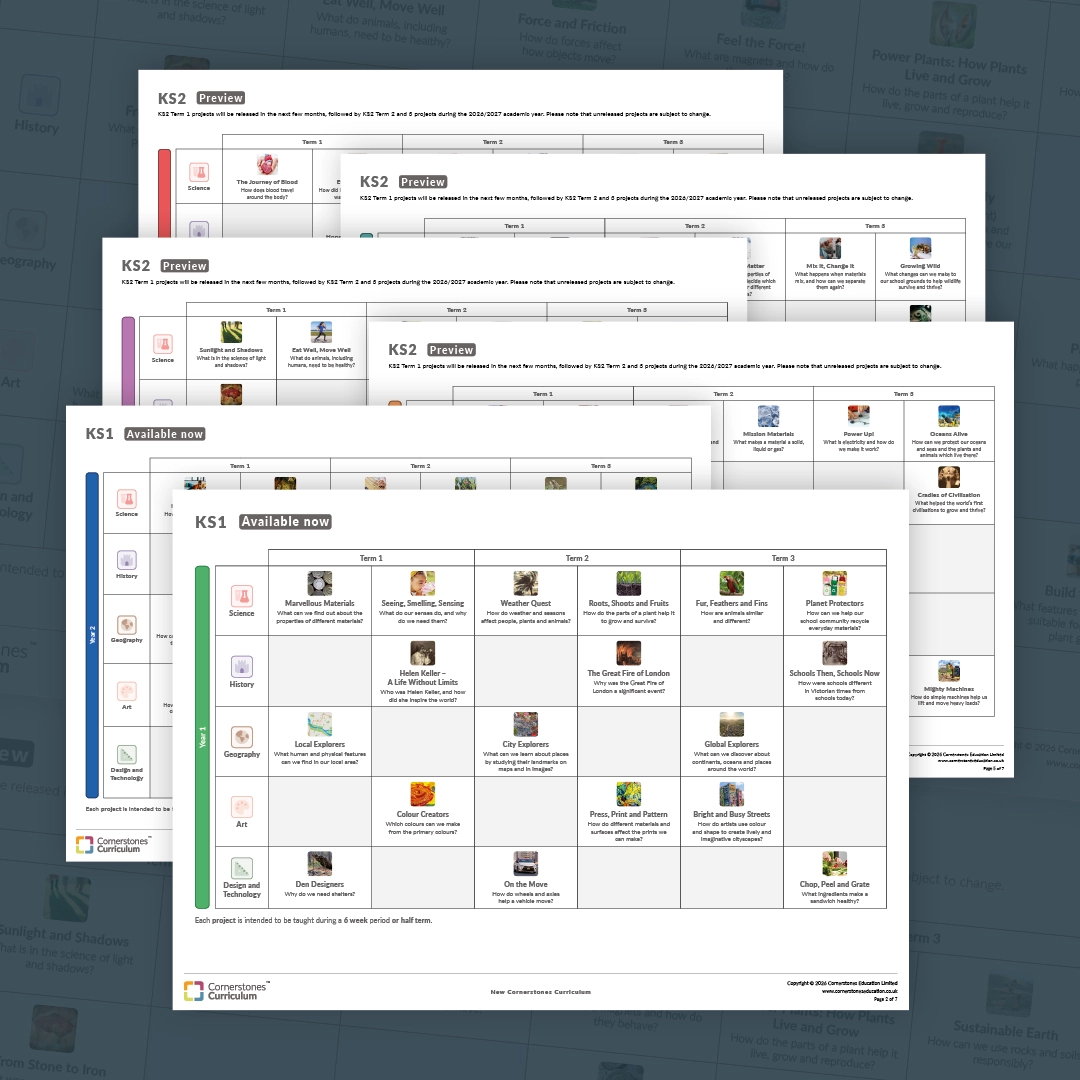
Where do you want your school to be?
The schools that feel confident in September 2028 are the ones making decisions in 2026 and 2027. Here is what the timeline looks like.
Now
Review your current curriculum against the new programmes of study. Identify gaps, understand what needs to change and begin planning your transition with a Cornerstones curriculum adviser.
September 2027
Early adoption. Schools using the new Cornerstones Curriculum are already teaching the updated content, building teacher confidence and embedding new assessment frameworks. A full year ahead of the statutory deadline.
September 2028
The new national curriculum becomes statutory. Cornerstones schools are already there. Schools that waited are starting now, under pressure, with less time and higher cost.
Cornerstones schools using Maestro will be automatically updated when the new national curriculum is confirmed. No manual updating, no additional cost, no disruption to teaching.

Starting now costs less than waiting
Curriculum change has unavoidable costs. The time investment of reviewing, redesigning and implementing a new curriculum. The budget required for new resources, staff development and adviser support. The leadership capacity needed to manage the transition while continuing to run a school.
Starting now makes all three manageable. The time investment is spread across two years rather than compressed into one. The budget can be planned and phased. The leadership capacity can be built gradually, with support from a dedicated Cornerstones adviser at every stage.
Waiting until 2028 means doing everything at once, under pressure, with a statutory deadline approaching. It means higher cost, higher stress and a higher risk of getting it wrong for the children currently in your school.
The schools that navigate change well are the ones that start early.
Schools that have been through curriculum change with Cornerstones
We have adapted the curriculum for our children, setting and packed timetable, but with the resourcing being all in one place, the curriculum constantly being updated and knowing that we will be supported through the changes ahead is very reassuring.
Alison Ashcroft
We've been with Cornerstones since the very beginning. The whole curriculum has evolved and developed over that time in response to national changes and changes that schools have talked about to become the quality curriculum that it is now.
Read their story
James Foxwell
Septembers come around fast. Start now.
Book a curriculum conversation today and find out how Cornerstones can help your school get ahead of the new national curriculum, at a pace and cost that works for you.